
Verified Freelancers vs Traditional Hiring: Which Is Better for Businesses?
LoudSup Team · Aug 14, 2026 · 4 min read
Verified Freelancers vs Traditional Hiring: Which Is Better for Businesses?
Hiring the right person can have a major impact on a business. Traditionally, companies have relied on full-time employees and lengthy recruitment processes to fill roles. Today, businesses also have another option: verified freelancers.
Freelancers can help companies access specialized skills, scale teams quickly and complete projects without committing to a long-term employment structure.
But does freelance hiring make more sense than traditional hiring?
The answer depends on your business needs, project requirements and hiring goals.
What Are Verified Freelancers?
Verified freelancers are independent professionals who offer specific skills and services to businesses on a project, contract or flexible basis.
Businesses can hire freelancers for areas such as:
Web Development AI & Automation Digital Marketing Design Content Writing Data & Analytics Mobile Development Admin Support
Instead of hiring someone permanently, businesses can find professionals based on the skills required for a specific project.
👉 Internal Link: “hire freelancers” → /hire-freelancers
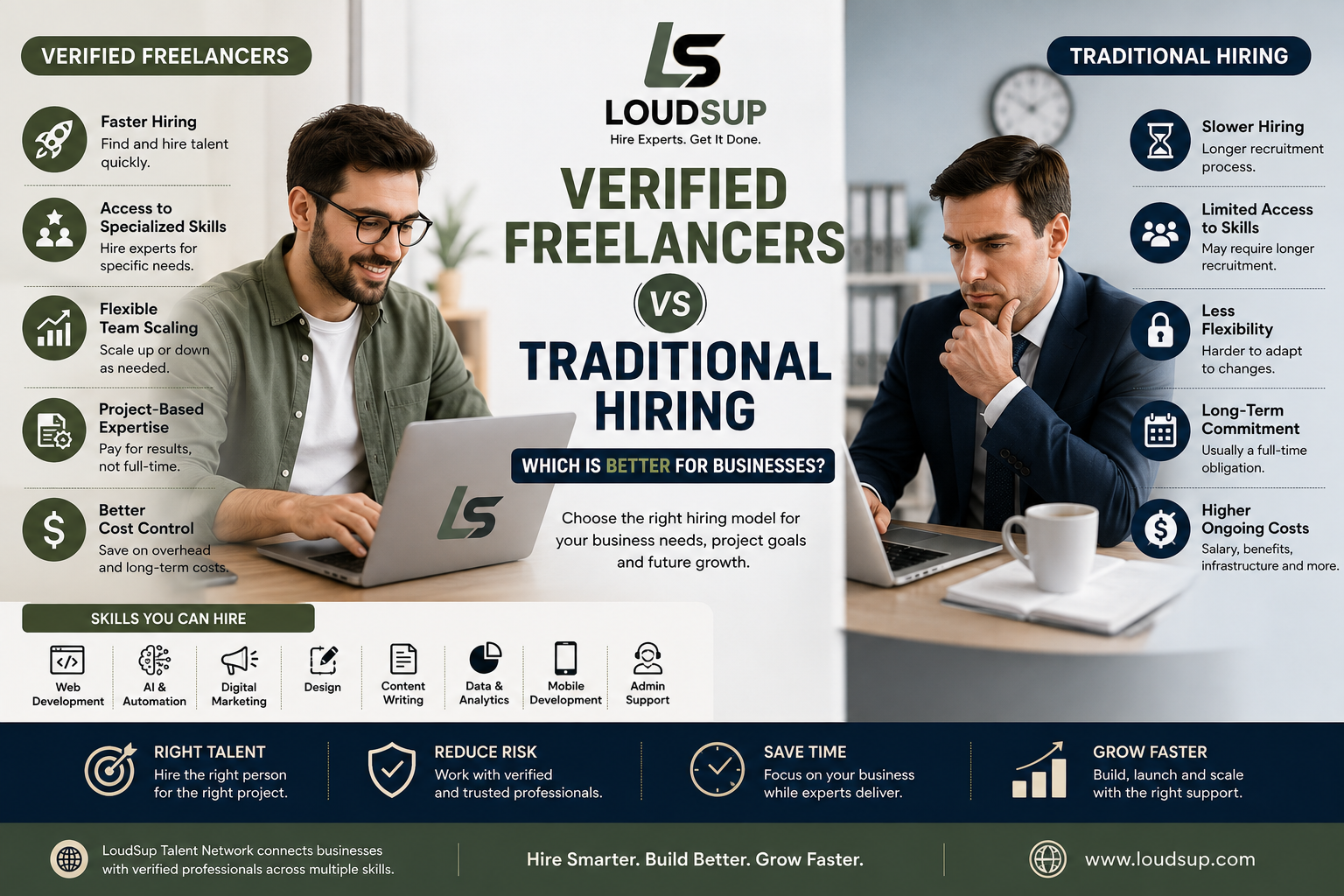
Verified Freelancers vs Traditional Hiring
Both approaches can work, but they offer different advantages.
Factor Verified Freelancers Traditional Hiring Hiring Speed Usually faster Often takes longer Flexibility High Lower Specialized Skills Easy to access May require longer recruitment Hiring Commitment Project/contract based Usually long-term Scaling Easy to scale up or down More difficult Remote Work Naturally suited Depends on company setup Project-Based Work Ideal Can be less efficient
For businesses working on short-term projects or looking for specialized expertise, freelancers can provide greater flexibility.
1. Faster Hiring
Traditional recruitment can involve job postings, applications, interviews, negotiations and onboarding.
For businesses that need a professional quickly, this process can become a bottleneck.
With freelance hiring, companies can search for professionals based on specific skills and project requirements.
This can make it easier to move from finding talent to starting the project.
2. Access to Specialized Skills
A business may need a developer for one project, an AI specialist for another and a digital marketer for a campaign.
Hiring a full-time employee for every requirement may not always make sense.
Businesses can instead hire freelance professionals with the exact skills they need.
For example:
Web Development freelancers can help build websites and applications.
AI & Automation freelancers can help businesses automate workflows and implement AI solutions.
Digital Marketing freelancers can support SEO, advertising, content and online growth.
3. Flexible Hiring
One of the biggest advantages of freelance hiring is flexibility.
Businesses can increase their workforce when projects increase and reduce external support when projects are completed.
This is especially useful for startups, growing businesses and companies working on project-based requirements.
4. Better Cost Control
Traditional employees usually involve more than salary.
Businesses may also need to consider:
Recruitment costs Onboarding Benefits Office infrastructure Training Long-term employment commitments
Freelance hiring can provide a more flexible cost structure because businesses can hire professionals according to their project requirements.
Important: The cheapest freelancer is not always the best choice.
Businesses should compare skills, experience, communication, reliability and overall value, not only hourly rates.
5. When Traditional Hiring Makes More Sense
Freelancers are not the answer to every hiring requirement.
Traditional employees may be a better choice when a business needs:
A permanent internal role Long-term team ownership Daily collaboration with an internal department A leadership position Continuous responsibilities that require full-time availability
The best hiring model depends on what the business actually needs.
6. When Should You Hire a Freelancer?
Freelancers can be a strong option when:
✅ You need specialized expertise
✅ You have a short-term project
✅ You need to hire quickly
✅ Your internal team lacks a specific skill
✅ You want flexible access to talent
✅ You are testing a new project or business idea
How to Choose the Right Freelancer
Before hiring, businesses should evaluate more than a profile or hourly rate.
Look for:
Relevant skills Previous project experience Portfolio quality Communication Client reviews or work history Availability Project understanding Budget compatibility
The goal is not simply to find a freelancer.
The goal is to find the right professional for your project.
Why Businesses Are Moving Toward Flexible Hiring
Modern businesses need to adapt quickly.
Instead of building large teams for every requirement, companies can combine internal employees with external specialists.
This allows businesses to access talent when they need it while keeping their operations more flexible.
A freelance marketplace can make this process easier by helping businesses discover professionals based on their skills and requirements.